Building Learning Experiences that Stick
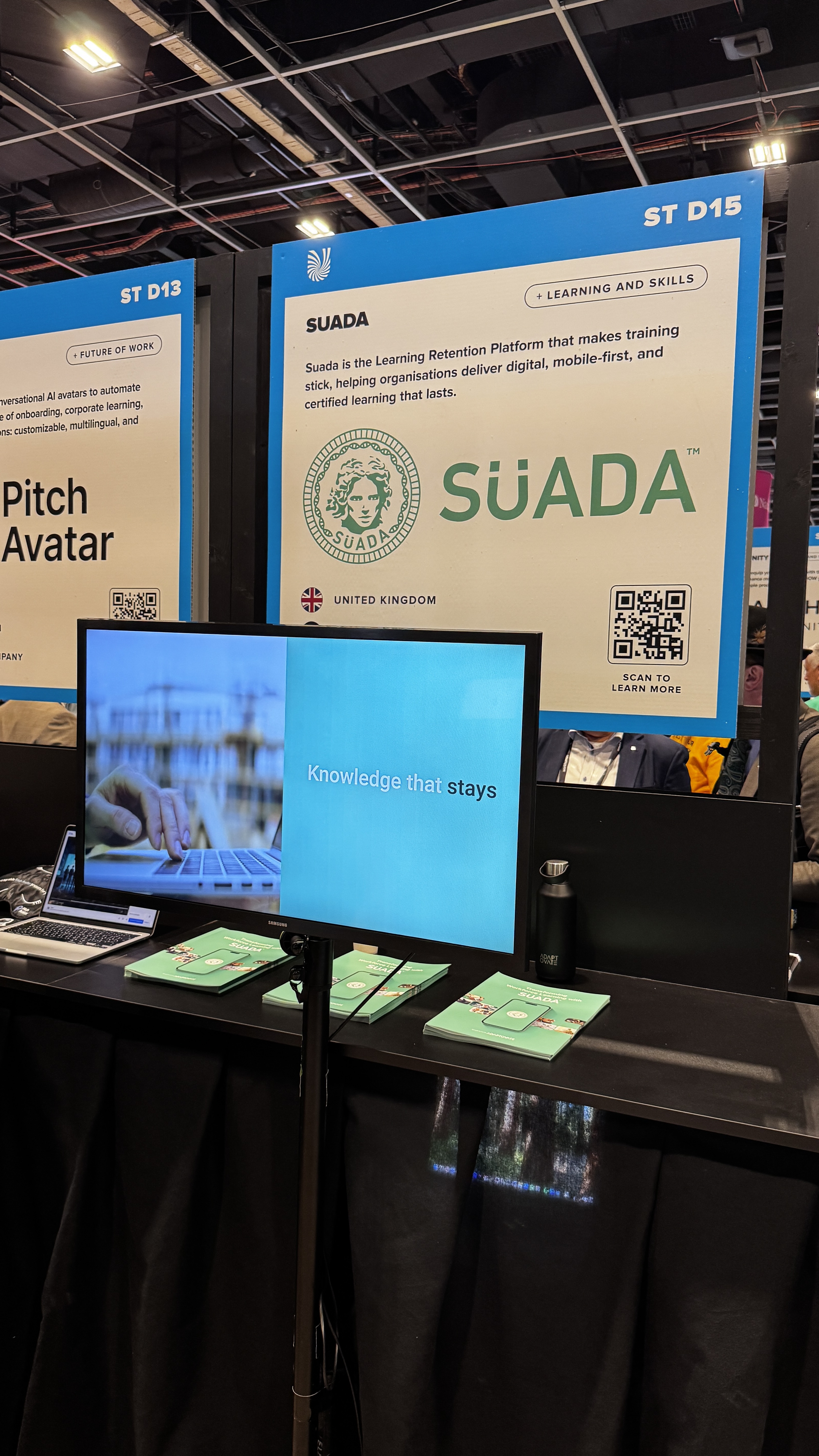
I've just come back from the Unleash HR Conference in Paris, and it's got me thinking. Spending a few days immersed in conversations with L&D professionals, HR leaders, and learning technology vendors has reinforced something I've been observing for years...
Most corporate learning and development is broken. Not just a bit ineffective or in need of minor tweaking, fundamentally broken. Organisations spend billions every year on L&D programmes, and the vast majority of that investment evaporates within days. People sit through courses, click through modules, watch videos, maybe even pass a quiz at the end. And then they go back to their jobs and do exactly what they were doing before.
This isn't because people are lazy or unmotivated. It's because the way we've built learning technology and designed L&D programmes is completely divorced from how humans actually learn and retain information.
I've spent years building Suada and working with organisations across different sectors, and what I've observed is this massive gap between what L&D professionals hope will happen and what actually happens when their people complete training. That gap exists because we've built learning experiences around the wrong principles.
Why Nobody Wants to Learn on Your LMS
Think about what happens when you want to learn something outside of work. Maybe you want to figure out how to fix your bike, or learn a new recipe, or understand how something works. Where do you go? YouTube. TikTok. You find someone who explains it in a way that makes sense, who keeps your attention, who makes it feel accessible.
YouTube is the world's biggest learning platform, and it's not even close. People voluntarily spend hours learning complex skills from creators who've figured out how to make content engaging. And sometimes, maybe more often than we'd like to admit, people are on YouTube during work hours learning the very skills their company has paid for corporate training to teach them.
Why? Because corporate learning content is often mind-numbingly dull. We've somehow decided that "professional" learning needs to look and feel completely different from the learning people actually engage with in their lives. Stiff presentation. Monotone voiceover. Walls of text. Stock photos of people in suits pointing at whiteboards.
This is part of what we're trying to change at Suada. If people are naturally drawn to learning from YouTubers and influencers who make content engaging, why wouldn't we build corporate learning that works the same way? Not dumbed down, but genuinely engaging. Content that respects that your learners are the same people who binge educational content online when it's actually good.
But making content engaging is only part of the problem. Even if your content is as compelling as the best YouTube video, you're still fighting against basic human biology.
The Forgetting Curve Doesn't Care About Your Completion Rates
People forget approximately 70% of what they've learned within 24 hours if they don't actively engage with it. This is the forgetting curve, a documented phenomenon that happens to all of us. Within a week, that figure climbs even higher. Within a month, most people retain almost nothing from passive learning experiences.
Let's think about how most corporate learning works. Someone logs into an LMS, watches a series of videos or clicks through slides, maybe answers some multiple-choice questions, gets their completion certificate, and moves on. The platform marks them as "complete." The L&D team reports that 95% of employees finished the training. Everyone feels good about the numbers.
But what actually stuck? What behaviour actually changed? What business outcome actually improved?
Most traditional L&D platforms are built around content delivery and completion tracking. They're designed to prove that learning happened, not to ensure that learning sticks. There's a world of difference between those two things.
What Actually Happens in Real Organisations
Building Suada and working with clients has given us this front-row seat to watch what actually happens when organisations try to upskill their people. The patterns are predictable.
When organisations use traditional approaches, even with genuinely good content, people complete the training. Managers get their completion reports. And then, weeks later, when someone needs to apply that skill in their actual work, it's like they never learned it at all. The knowledge didn't transfer. The behaviour didn't change. The business outcome didn't improve.
But when organisations build learning experiences around active engagement rather than passive consumption, everything changes. We've watched people go from completing training and forgetting it immediately to completing training and actually applying it confidently in their roles weeks and months later.
The difference isn't the quality of the content. Often it's exactly the same content. The difference is how people engage with it.
Your Brain Needs You to Do Something
You cannot passively absorb information and expect it to stick. Your brain doesn't work that way. Reading something or watching something creates weak neural pathways. You might recognise the information if you see it again, but you won't be able to recall it when you need it.
When you actively engage with information, when you have to process it, synthesise it, articulate it in your own words, demonstrate your understanding, you create much stronger neural pathways. This isn't me just pushing an agenda here, this is neuroscience!
We worked with Professor Dean Mobbs at California Institute of Technology to make sure that what we were building mapped to actual brain science. Professor Mobbs helped us understand how neural pathways are formed through active retrieval and articulation. When you teach something, your brain does fundamentally different work than when you simply consume it.
You're not just retrieving information from memory, you're organising it coherently, connecting it to other knowledge, finding ways to explain it clearly, anticipating questions, thinking about examples. That cognitive work creates retention. That's what builds lasting knowledge and, critically, the confidence to apply that knowledge.
Why Teach-Back Changes Everything
This is where the teach-back methodology becomes transformative. When learners have to record themselves teaching back what they've learned, explaining the concepts in their own words, demonstrating their understanding - several things happen at once.
First, they're forced into active engagement. There's no hiding behind multiple choice questions or clicking "next" until they reach the end. They have to genuinely process and understand the material well enough to articulate it.
Second, they're building neural pathways through the act of teaching. Their brains are doing the deep cognitive work that creates retention. They're not just recognising information; they're able to recall and apply it.
Third, and this is crucial, they're building confidence. When someone records themselves teaching a concept, watches it back, maybe re-records it to improve their explanation, they're actually transforming their self-image. They go from "I'm someone learning about this" to "I'm someone who knows this well enough to teach it." That psychological shift is profound.
We've watched this happen with clients across different sectors. People who complete traditional training often feel uncertain about applying new skills. People who complete teach-back training feel confident. They've already demonstrated their competence to themselves. They know they can do it because they've already done it.
The Metrics That Actually Matter
What frustrates me most about traditional L&D is this massive disconnect between learning outcomes and business outcomes.
L&D teams measure completion rates, quiz scores, satisfaction surveys. These are learning outcomes, metrics that tell you whether people finished the training and whether they liked it. But they tell you almost nothing about whether the training achieved what it was actually supposed to achieve.
What was the point of the compliance training? To reduce incidents and avoid regulatory issues. What was the point of the sales training? To increase win rates and deal sizes. What was the point of the leadership development? To improve team performance and retention.
Those are business outcomes. And most L&D programmes have no line of sight between their learning outcomes and those business outcomes.
We've worked with organisations who could tell us that 98% of their workforce completed safety training, but couldn't tell us whether incidents decreased. Who knew that people scored an average of 87% on their sales training quiz, but didn't track whether those people were actually closing more deals.
Building learning experiences that stick means building learning experiences that map to business outcomes. It means asking not just "did they complete it?" but "did their behaviour change?" and "did that behaviour change improve business results?"
When learning truly sticks, when people retain it, when they're confident applying it, when it changes how they work - you see it in business metrics. You see fewer errors, you see higher sales, you see better customer satisfaction and you see improved efficiency.
If you can't draw a line from your L&D programme to a business outcome that matters, you're probably measuring the wrong things.
What Actually Becomes Possible
We now know how to build learning experiences that actually stick. The science is clear and the methodology is proven. The technology exists to deliver it at scale.
Imagine an L&D function where you don't just report completion rates to leadership, you report business impact. Where you can show that the training programme didn't just educate people about the new process, it actually improved efficiency by a measurable amount. Where leadership sees L&D not as a cost centre or a compliance necessity, but as a strategic driver of performance.
That's not a fantasy. That's what becomes possible when you build learning experiences around how humans actually learn rather than around what's easy to track in a traditional LMS.
It requires a fundamental shift in thinking. You have to move from "how do we get people through this content?" to "how do we ensure people can actually apply this skill?" You have to move from passive consumption to active engagement. You have to move from learning outcomes to business outcomes.
Organisations that make this shift see the results. They see people who actually retain what they've learned. They see employees who are confident applying new skills. They see behaviour change that translates to business impact.
What Are You Actually Building?
Every organisation has a choice to make about L&D. You can keep doing what you've always done, buying or building traditional platforms, measuring completion rates, hoping that somehow this time the learning will stick even though you're using the same approaches that have never worked before.
Or you can acknowledge that most of what we've built in corporate L&D is fundamentally broken, and commit to building something better. Something grounded in how humans actually learn. Something that creates active engagement rather than passive consumption. Something that maps learning outcomes to business outcomes. Something that actually sticks.
What's missing is the willingness to admit that what we've been doing doesn't work and the courage to do something different.
The organisations that make this shift, that build learning experiences around teach-back methodology, active engagement, and business impact, will have workforces that genuinely develop and grow. Their people won't just complete training; they'll master skills. They won't just know things; they'll be confident applying them. And their businesses won't just invest in L&D, they'll see returns from it.
That's what's possible when you build learning experiences that actually stick. My question to you is: are you ready to change?